
How to Calculate LTL Freight Density (PCF) and NMFC Class
Less-Than-Truckload (LTL) carriers price freight based on how efficiently a pallet uses trailer cube and payload capacity. Under the National Motor Freight Classification (NMFC) framework maintained by the National Motor Freight Traffic Association (NMFTA), density-based freight class depends directly on pounds per cubic foot (PCF).
To calculate freight density accurately, measure the outermost length, width, and height of each packaged handling unit in inches—including the wood pallet, overhang, strapping, and protective top cap. Multiply Length × Width × Height to find cubic inches, divide by 1,728 to convert to cubic feet (CFT), and divide total gross weight in pounds by total cubic feet.
When a single Bill of Lading (BOL) contains multiple pallets or crates of the same density-classified commodity, carriers typically evaluate combined shipment density (Total Gross Weight ÷ Total Cubic Feet) across all pieces tendered together. Entering every pallet line in our multi-pallet calculator prevents averaging errors that lead to costly carrier reweigh and reclassification invoices.
- Cubic Feet (CFT) = (Length in × Width in × Height in) ÷ 1,728
- Imperial Density (PCF) = Total Gross Weight (lbs) ÷ Total Volume (ft³)
- Metric Density (kg/m³) = Total Weight (kg) ÷ Total Volume (CBM); 1 PCF = 16.0185 kg/m³
- Always include pallet deck height (typically 5.5 to 6 inches) and empty pallet weight (35 to 50 lbs for a standard 48×40 hardwood GMA pallet).
Worked Freight Density Examples (Single Pallet & Multi-Pallet BOL)
Example 1 — Single Standard Pallet with Pallet Height Included: Suppose a warehouse ships one boxed machinery parts pallet measuring 48 in long × 40 in wide × 42 in tall for the freight alone, resting on a 6 in hardwood GMA pallet, with a combined gross scale weight of 650 lbs. Total height equals 42 + 6 = 48 in. Cubic inches equal 48 × 40 × 48 = 92,160 in³. Dividing by 1,728 gives 53.33 ft³ (1.510 CBM). Dividing 650 lbs by 53.33 ft³ produces 12.19 PCF (195.2 kg/m³), which falls into the 12 to < 15 PCF bracket: NMFC Class 85. Notice how close this pallet is to Class 70 (15 PCF): lowering the stack height from 48 in to 39 in trims volume to 43.33 ft³ and raises density to 15.00 PCF, dropping the shipment into Class 70 without removing a single product.
Example 2 — Multi-Pallet Mixed-Size Shipment: Suppose a distributor tenders two standard pallets (48 × 40 × 42 in, 850 lbs each) plus one wooden crate (60 × 36 × 30 in, 320 lbs) under one density-based NMFC item. Line 1 occupies 2 × (80,640 ÷ 1,728) = 93.33 ft³ and weighs 1,700 lbs. Line 2 occupies 64,800 ÷ 1,728 = 37.50 ft³ and weighs 320 lbs. Combined volume is 130.83 ft³ (3.705 CBM) and combined gross weight is 2,020 lbs. Total shipment density is 2,020 ÷ 130.83 = 15.44 PCF, qualifying the combined shipment for NMFC Class 70 (15 to < 22.5 PCF).
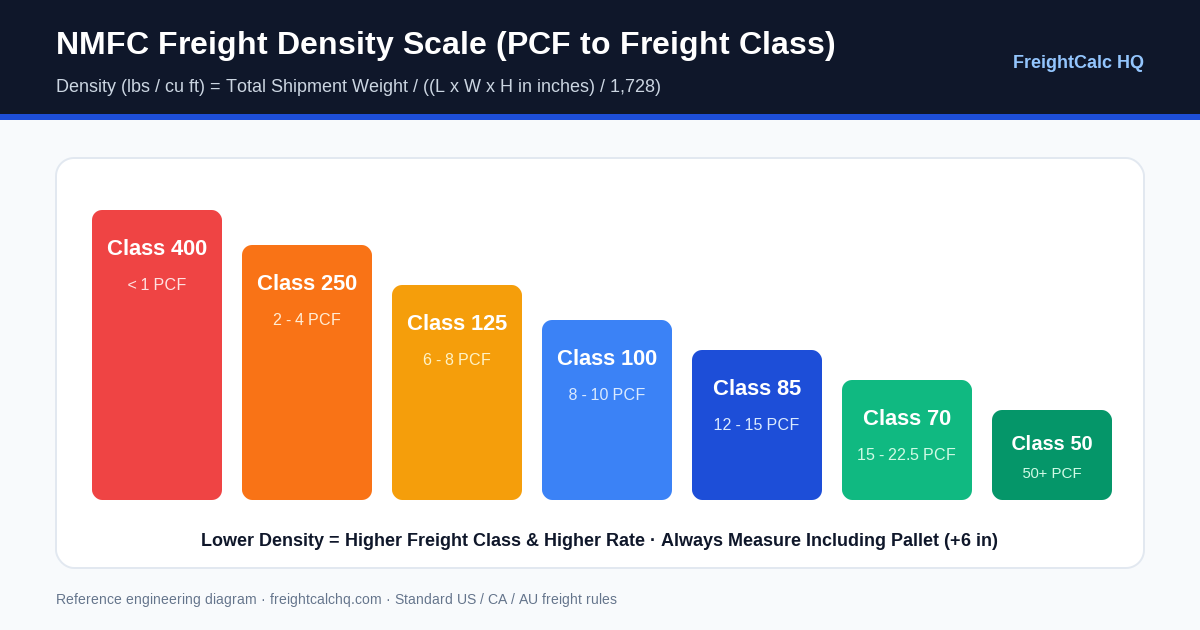
NMFC 13-Tier Full-Scale Density Reference Table
Following the 2025/2026 NMFC modernization initiatives by NMFTA, a growing majority of LTL commodities without specialized handling, stowability, or liability risks are assigned directly to the standardized 13-tier full-scale density table below.
| NMFC Class | Density Range (PCF) | Metric Density (kg/m³) | Typical LTL Commodities |
|---|---|---|---|
| Class 50 | 50+ PCF | 800.9+ kg/m³ | Steel bars, dense stone, nuts and bolts, metal fittings |
| Class 55 | 35 to < 50 PCF | 560.6 – 800.9 kg/m³ | Bricks, cement, mortar, dense hardwood flooring |
| Class 60 | 30 to < 35 PCF | 480.6 – 560.6 kg/m³ | Auto accessories, bottled liquids, dense plastics |
| Class 65 | 22.5 to < 30 PCF | 360.4 – 480.6 kg/m³ | Boxed books, bottled beverages, machined car parts |
| Class 70 | 15 to < 22.5 PCF | 240.3 – 360.4 kg/m³ | Bagged feed, packaged food, crated engines |
| Class 85 | 12 to < 15 PCF | 192.2 – 240.3 kg/m³ | Crated machinery, boxed auto parts, cast iron stoves |
| Class 92.5 | 10 to < 12 PCF | 160.2 – 192.2 kg/m³ | Monitors, computers, commercial refrigeration units |
| Class 100 | 8 to < 10 PCF | 128.1 – 160.2 kg/m³ | Boat covers, wine cases, canvas goods |
| Class 125 | 6 to < 8 PCF | 96.1 – 128.1 kg/m³ | Small household appliances, vending machines |
| Class 175 | 4 to < 6 PCF | 64.1 – 96.1 kg/m³ | Clothing racks, display stands, stuffed furniture |
| Class 250 | 2 to < 4 PCF | 32.0 – 64.1 kg/m³ | Mattresses, bamboo furniture, empty corrugated boxes |
| Class 300 | 1 to < 2 PCF | 16.0 – 32.0 kg/m³ | Wood cabinets, kayaks, assembled plastic furniture |
| Class 400 | Less than 1 PCF | < 16.0 kg/m³ | Foam insulation, empty plastic drums, ping-pong balls |
How to Prevent LTL Reweigh and Reclassification Fees
Modern LTL cross-dock terminals use automated overhead laser dimensioners and forklift scales to audit incoming freight in seconds. If a carrier dimensioner measures a pallet two inches taller than declared on the Bill of Lading—or detects a non-stackable cone on top of a pallet—your calculated PCF drops, pushing the shipment into a higher freight class and triggering both a tariff rate jump and an administrative reclassification fee.
Always print your exact measured dimensions, gross scale weight, PCF density, and verified NMFC item number directly on the BOL before the pickup driver arrives. Photograph the pallet beside a tape measure on your dock if the shipment sits near a density tier boundary.
- Eliminate empty headroom: trim corrugated shippers or fold down oversized gaylord box walls so laser scanners do not bill dead air.
- Keep freight strictly inside the 48×40 in pallet footprint: even 2 inches of carton overhang expands the measured bounding box across the entire height of the pallet.
- Check the Next Better Class Tip above before shrink-wrapping: adding small dense accessory cartons or splitting tall light cartons onto a separate BOL can move an entire shipment down one class tier.
- Verify whether your commodity has a dedicated NMFC item number based on stowability, handling, or liability rather than pure density.