
FreightCalc HQ
LTL Freight & NMFCReviewed November 28, 2026 · By Oscar Sanz · Methodology

LTL Freight Cost & Rate Estimator

Model indicative LTL shipping costs using hundredweight (CWT) pricing, NMFC freight class multipliers, lane mileage, diesel fuel surcharge percentage, and common delivery accessorials.

LTL Freight Cost & Rate Estimator

Model hundredweight (CWT) linehaul, NMFC class factor, diesel fuel surcharge, and terminal accessorials.

12 CWT (hundredweight)
Class rate factor: 1.14×
Typical LTL FSC ranges from 22% to 35% of linehaul
Accessorial Services
Estimated LTL Rate Range
$551.86
Typical Market Spread: $469.08 – $662.23
Low (-15%)
$469.08
Mid Est.
$551.86
High (+20%)
$662.23
Cost Breakdown
Base Linehaul (12 CWT × Class 85)
$356.92
Fuel Surcharge (28%)
$99.94
Accessorial Services
$95.00
Estimated Midpoint Total
$551.86

Non-Binding Planning Estimate: Actual LTL shipping charges vary by lane density, origin/destination ZIP codes, negotiated carrier discount tables, Freight All Kinds (FAK) contracts, minimum charge floors, and carrier-specific rules tariffs. Always confirm your final quote against a binding carrier or brokerage rate confirmation.

Next Step in LTL Freight
Not Sure of Your NMFC Class? Calculate Density First

Measure your pallets and compute exact PCF density to find your estimated NMFC freight class before budgeting LTL shipping rates.

Open Tool
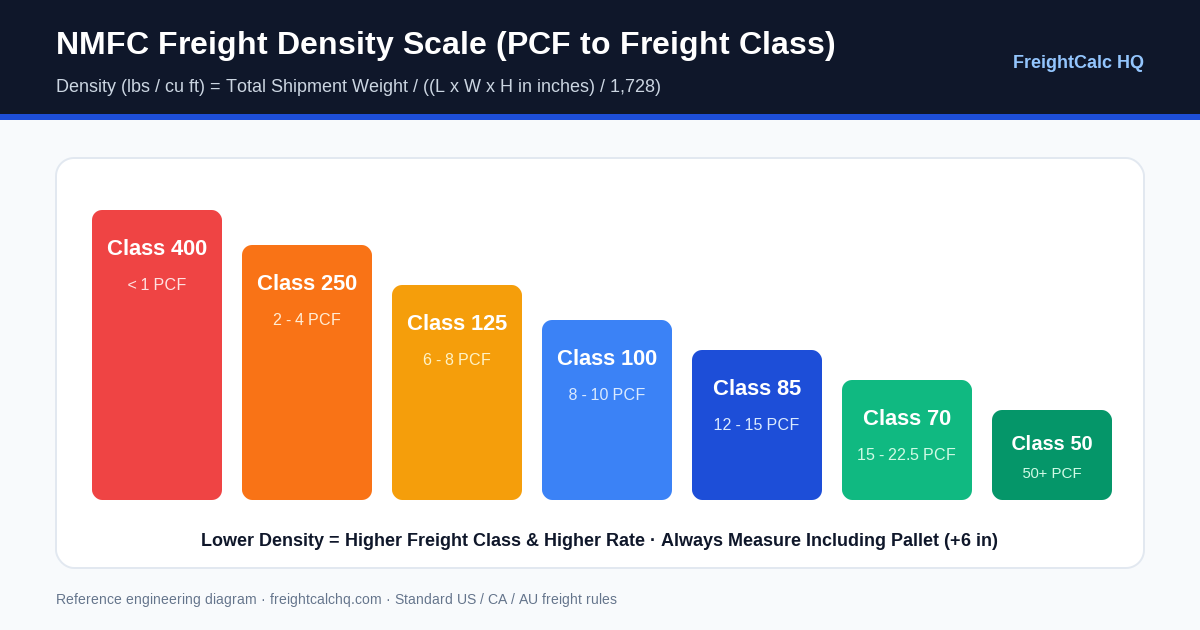
NMFC freight class scale illustrating how lower freight classes reduce LTL base tariff multipliers
NMFC freight class directly drives the LTL tariff multiplier applied to base hundredweight (CWT) linehaul rates before fuel surcharge and accessorial fees.

How LTL Freight Rates Are Calculated (CWT, Class, FSC & Accessorials)

Unlike parcel shipping, Less-Than-Truckload (LTL) freight pricing is structured around hundredweight (CWT)—defined as total shipment weight divided by 100 pounds—combined with an origin-to-destination base tariff, an NMFC freight class multiplier, a weekly diesel fuel surcharge (FSC), and itemized accessorial fees.

Every LTL shipment is also subject to a carrier Absolute Minimum Charge (AMC). Even if a 180 lb pallet multiplies out to $68 in raw CWT linehaul, the carrier bills its minimum floor (commonly $120 to $175 depending on lane and contract) plus fuel surcharge and any extra pickup or delivery services.

As shipment weight crosses standard LTL weight breaks—500 lbs, 1,000 lbs, 2,000 lbs, 5,000 lbs, and 10,000 lbs—the rate per CWT steps downward. In some cases, declaring a slightly higher weight break ("deficit weight rating") produces a lower total linehaul charge than billing at the actual weight.

  • Hundredweight (CWT) = Gross Shipment Weight (lbs) ÷ 100
  • Base Linehaul = Max(Minimum Charge Floor, CWT × Lane Base Rate × NMFC Class Factor × Weight-Break Discount)
  • Fuel Surcharge (FSC) = Base Linehaul × Weekly Carrier FSC % (pegged to U.S. EIA/DOE Retail Diesel Price)
  • Total Estimated Cost = Base Linehaul + Fuel Surcharge + Accessorial Charges

Worked LTL Shipping Cost Examples (Standard vs. Reclassified Freight)

Example 1 — Dock-to-Liftgate Commercial Shipment: A distributor ships 1,200 lbs (12.00 CWT) of boxed industrial hardware at NMFC Class 85 over a 650-mile regional lane with a 28% fuel surcharge and liftgate delivery ($95). At an indicative base rate of $29.00 per CWT, applying the Class 85 multiplier (1.14×) and a 10% weight-break reduction for exceeding 1,000 lbs yields $357.05 in estimated linehaul (12 × $29.00 × 1.14 × 0.90). Adding the 28% fuel surcharge ($99.97) and liftgate delivery ($95.00) produces an estimated midpoint total of $552.02, with typical contracted market quotes falling between $469 and $662.

Example 2 — Financial Impact of an NMFC Reclassification: Consider a 600 lb (6.00 CWT) shipment traveling 400 miles with a 26% fuel surcharge plus residential ($115) and liftgate ($95) delivery ($210 total accessorials). At an indicative $23.80/CWT base rate, quoting accurately at Class 70 (0.98×) yields $139.94 linehaul + $36.38 FSC + $210.00 accessorials = $386.32. If the pallet is measured taller at the terminal and reclassified to Class 125 (1.62×), linehaul jumps to $231.34 and FSC rises to $60.15—bringing the freight bill to $501.49 before adding a carrier inspection and reclassification fee ($150–$250).

Common LTL Accessorial Charges and Typical Budget Ranges

Accessorials are the single fastest way an LTL invoice exceeds its original budget. Because linehaul rates only cover dock-to-dock commercial transport during standard business hours, any non-dock delivery condition triggers a line-item surcharge.

Accessorial ServiceTypical Market RangeWhen Carriers Apply It
Liftgate Pickup or Delivery$75 – $135 per endShipper or consignee lacks a truck-height loading dock or forklift
Residential Pickup / Delivery$95 – $165Non-commercial address, home-based business, or farm
Limited Access Delivery$85 – $150Construction sites, schools, churches, storage units, military bases
Delivery Appointment / Notify$35 – $75Consignee requires carrier call-ahead scheduling before delivery
Inside Delivery$100 – $225+Driver moves freight past the threshold or loading dock door
Reweigh / Reclassification$75 – $250 + rate diffTerminal scale or laser scan disagrees with declared BOL weight or class

Practical Ways Shippers Lower LTL Freight Costs

Because LTL tariffs multiply base rates heavily by NMFC class and accessorial count, small operational adjustments on the shipping dock regularly save 15% to 30% without switching transit lanes.

Consolidating two separate weekly orders to the same consignee onto a single Bill of Lading eliminates a second minimum charge floor and unlocks lower per-CWT weight breaks. Likewise, requesting terminal-to-terminal ("hold at terminal") pickup for consignees without a loading dock removes both liftgate and residential delivery fees.

  • Consolidate partial orders into fewer weekly BOLs to clear 1,000 lb or 2,000 lb weight breaks.
  • Negotiate Freight All Kinds (FAK) brackets once your annual LTL volume reaches consistent weekly pallet counts.
  • Audit pallet height before tendering so density sits cleanly inside the lowest defensible NMFC class tier.
  • Use hold-at-terminal delivery whenever a residential or limited-access consignee can pick up freight locally.

Frequently Asked Questions

Why does LTL freight pricing use hundredweight (CWT) instead of per-pound rates?▾

North American LTL base tariffs have historically been published in rates per 100 pounds (hundredweight, or CWT) across standardized weight brackets such as L5C (under 500 lbs), 5C (500–999 lbs), 1M (1,000–1,999 lbs), and 2M (2,000–4,999 lbs). Expressing rates per CWT makes tariff comparison across weight breaks straightforward and lets our LTL Freight Cost Estimator separate linehaul scaling from fuel and accessorials.

How is the LTL fuel surcharge percentage determined each week?▾

Most LTL carriers publish a weekly fuel surcharge matrix tied directly to the U.S. Energy Information Administration (EIA / DOE) National Average On-Highway Diesel Fuel Price released every Monday. As retail diesel prices move up or down in 5-cent or 10-cent increments, the contracted percentage applied to LTL linehaul charges adjusts automatically the following Tuesday or Wednesday.

Why do two LTL carriers quote very different rates for the same pallet and distance?▾

LTL carriers operate hub-and-spoke terminal networks with unique lane imbalances. A carrier needing backhaul freight out of a specific ZIP code may offer steep tariff discounts, while another carrier with congested cross-docks on that lane prices higher. Carrier-specific minimum charges, FAK contracts, and accessorial waivers also create wide quote spreads, which is why our estimator shows a Low, Mid, and High planning range.

What is deficit weight rating in LTL shipping?▾

Deficit weight rating occurs when rating a shipment at the minimum weight of the next higher weight bracket costs less than rating it at its actual weight. For example, a 940 lb shipment billed at the 1,000 lb (1M) lower per-CWT rate can produce a smaller linehaul charge than 940 lbs billed at the 500–999 lb rate. Most carrier rating engines apply deficit weight automatically.

When is a location classified as Limited Access by an LTL carrier?▾

Under standard LTL rules tariffs, Limited Access applies to commercial sites where a 53-foot tractor-trailer faces restricted entry, security delays, or lack of standard dock staffing—such as self-storage facilities, construction job sites, schools, churches, airports, prisons, camps, and strip malls without dedicated freight docks. Declaring limited access upfront prevents post-delivery billing disputes.

How much does a liftgate add to an LTL freight shipment?▾

Liftgate service typically adds $75 to $135 per stop depending on carrier tariff and contract terms, with $95 representing a common mid-market benchmark in our LTL Cost Estimator. If neither the origin nor the destination has a loading dock or forklift, liftgate fees apply separately at both pickup and delivery.

Does freight class affect the fuel surcharge amount?▾

Yes, indirectly. Because LTL fuel surcharge is calculated as a percentage of the net linehaul charge rather than a flat fee per mile, moving a shipment to a higher NMFC freight class increases the base linehaul charge and simultaneously enlarges the dollar amount of the fuel surcharge—compounding the cost of inaccurate freight classification.

Is this LTL Freight Cost Estimator a binding shipping quote?▾

No. FreightCalc HQ is an independent engineering and calculation reference, not a motor carrier or freight broker. The LTL Freight Cost Estimator provides a non-binding market planning range based on CWT, NMFC class, mileage, fuel surcharge, and typical accessorial benchmarks so logistics teams can budget landed shipping expenses before requesting binding carrier tariffs.

Official Standards & Regulatory References

More Tools in LTL Freight & NMFC

View LTL Freight Hub →