
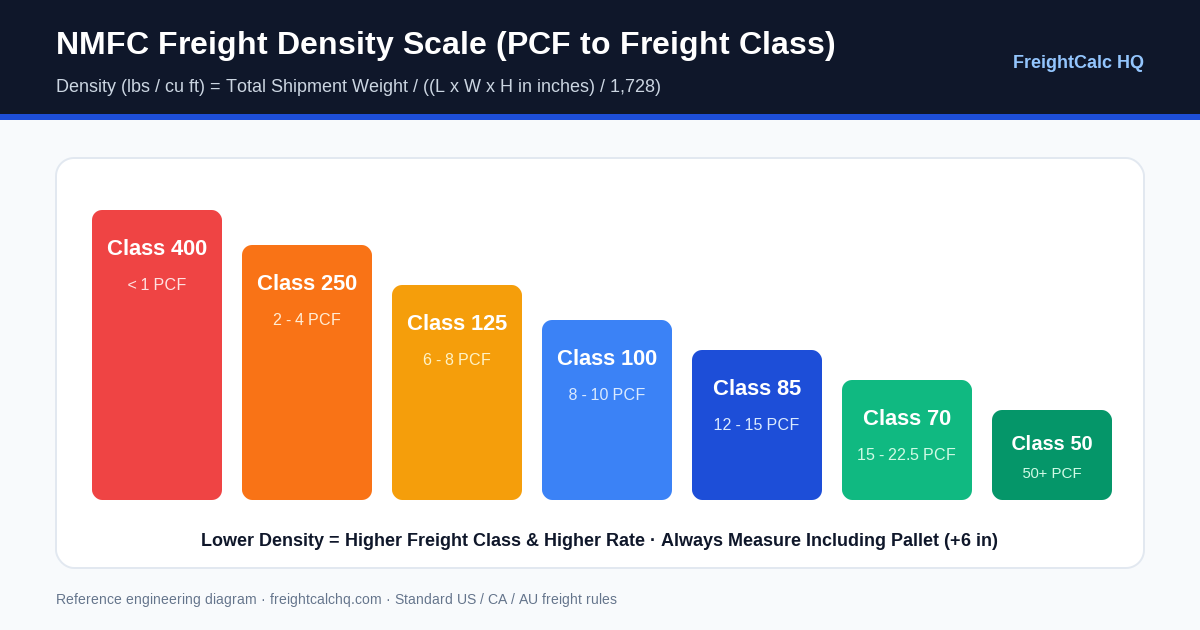
Understanding the NMFC Freight Classification System
The National Motor Freight Classification (NMFC) is the standardized commodity rating framework published by the National Motor Freight Traffic Association (NMFTA) and used across North American Less-Than-Truckload (LTL) carriers. Rather than pricing every product from scratch, carriers map thousands of commercial commodities into standardized numbered freight classes ranging from Class 50 (densest, easiest to transport) up to Class 500 (lightest, bulkiest, or highest liability).
Under NMFTA’s 2025/2026 classification modernization, thousands of general freight items without unusual handling, stowability, or liability characteristics were consolidated onto the standardized 13-tier full-scale density table shown at the top of this page. For density-based items, accurate measurement of gross weight and packaged cubic volume is the single factor that determines freight class.
- Density: Gross weight divided by packaged cubic feet (PCF). The dominant factor for standardized boxed and palletized cargo.
- Handling: Ease or difficulty of loading and transferring cargo with standard forklifts without specialized rigging.
- Stowability: Compatibility with other freight in a 53-foot dry van—hazardous materials, excessive lengths, or non-stackable shapes increase class.
- Liability: Susceptibility to theft, damage, perishability, or high replacement value per pound.
Worked Examples Using the NMFC Density Chart
Example 1 — Dense Industrial Valves (Class 60): A machine shop palletizes boxed brass valves onto a 48 × 40 in GMA pallet. Including the 6-inch pallet base, total stack height is 36 inches and gross scale weight is 1,280 lbs. Volume equals (48 × 40 × 36) ÷ 1,728 = 40.00 ft³. Density equals 1,280 ÷ 40.00 = 32.00 PCF (512.6 kg/m³). Checking the NMFC density chart above, 30 to < 35 PCF maps cleanly to Class 60.
Example 2 — Bulky Padded Office Chairs (Class 250): A furniture supplier ships assembled foam-padded chairs stacked 66 inches high on a 48 × 40 in pallet with a gross weight of 260 lbs. Volume equals (48 × 40 × 66) ÷ 1,728 = 73.33 ft³. Density equals 260 ÷ 73.33 = 3.55 PCF (56.8 kg/m³). On the NMFC density table, 2 to < 4 PCF assigns Class 250. If the same chairs ship knocked down (KD) flat in cartons at 32 inches high, volume falls to 35.56 ft³, density jumps to 7.31 PCF, and the shipment drops all the way to Class 125.
How NMFC Class Impacts LTL Tariff Multipliers
While every LTL carrier maintains its own base rate table and discount structure, relative pricing across NMFC classes follows a steep upward curve. Shipping a pallet at Class 175 typically costs more than twice as much in base linehaul as shipping the exact same weight at Class 70 over the same lane.
| NMFC Class Band | Density Range (PCF) | Indicative Relative Tariff Factor | Operational Profile |
|---|---|---|---|
| Class 50 – 60 | 30+ PCF | 0.72× – 0.84× | Heavy industrial metals, tile, fasteners, dense liquids |
| Class 65 – 70 | 15 to < 30 PCF | 0.90× – 0.98× | Standard boxed consumer goods, food, auto parts |
| Class 85 – 100 | 8 to < 15 PCF | 1.14× – 1.35× | Mixed warehouse pallets, electronics, boxed equipment |
| Class 125 – 175 | 4 to < 8 PCF | 1.62× – 2.15× | Appliances, light displays, bulky retail packaging |
| Class 250 – 400 | < 4 PCF | 2.95× – 4.35× | Assembled furniture, insulation, empty containers |
Five Practical Steps to Avoid LTL Reclassification Fees
Reclassification (reclass) adjustments happen when an LTL carrier’s inspection team audits a shipment at a cross-dock terminal and determines the actual density or NMFC item number differs from the Bill of Lading. Beyond charging the higher freight class rate, carriers routinely tack on an administrative fee and void contracted FAK protections when dimensions are omitted from the BOL.
- Write exact L × W × H inches, total weight, calculated PCF, and NMFC item number (with sub-number) on every Bill of Lading.
- Weigh the entire finished pallet on a calibrated floor scale—never rely on catalog product net weight alone.
- Measure from the widest protruding carton corner and the highest point of the pallet, including wood deck height.
- Ship knocked-down (KD) or nested whenever possible; NMFC items frequently reward KD packaging with substantially lower classes.
- Keep a timestamped dock photo next to a measuring stick for borderline density shipments so you can dispute erroneous dimensioner scans quickly.